recently some very farsighted and friendly folks brought out some new software that allows easy and cheap international phone calls. please visit www.skype.com to download free software that lets you call anywhere you want.
if one of those places you want is my cellular phone, give me a shout at 977 985 100 3829. if you 'skype' someone with skype, then the call is totally free.
three cheers for technology!
Friday, January 26, 2007


research report submission
Today I submitted a short report regarding my research in Nepal to be published in a forthcoming issue of Himalaya Journal, a publication by the Association for Nepal and Himalayan Studies. It is only about 450 words, so here it is:
The Newars, considered to be the original inhabitants of the Kathmandu Valley, have a long history of contact with the spread of Buddhism. Although Newar culture has been heavily influenced by Hindu social structure, many Newars continue to practice their traditional form of Vajrayana Buddhism. While Tibetans also practice Vajrayana, hundreds of years of isolated development led to the emergence of two very unique Buddhist systems.
There is an opinion amongst many Newar Buddhists that what remains of their highly ritualized system is aberrant and flawed. They point out that although Buddhist doctrine shuns caste discrimination, idealizes the role of celibate monks, and emphasizes personal study and meditation; the Buddhism of the Kathmandu Valley remains bound by a hierarchy of purity, where the tradition of fully ordained monks and nuns is a distant historical memory and the ritual priests are no longer able to expound philosophy and the practical path of meditation to the public. Due to this, Tibetan and Theravadin Buddhism have been embraced by many Newars, displaying a range of attitudes, from the profoundly ecumenical to fiercely competitive.
In the past half-century, many Tibetan lamas have made the Kathmandu Valley their new home. Many local Nepalis, especially Newar Buddhists, found an authentic and open teacher in one such lama, Tulku Orgyen Rinpoche. Tulku Orgyen was a prolific teacher, and his legacy includes a number of highly qualified teachers and monasteries in the Kathmandu Valley. Their connection with Newar Buddhists has continued to develop in a modern context, as both Tibetan and Newari understanding about what it means to be an active Buddhist practitioner evolves. Traditional roles are changing; Newar Buddhist scholars are trained both in the monastery and the modern university context, Newar monks come from farmer and trader castes, rather than just the priestly, and lay Newars take Tantric initiation from Tibetan gurus alongside Nepalis from Hindu backgrounds and Western students.
My research in the Kathmandu Valley aims to record my observations of and discussions with those Newar Buddhists who have accepted Tibetan lamas as their teachers, paying particular attention to new synthesis in Buddhist practice and ritual. The small Newar town of Chapagaon serves as an ideal case study site for my research. A few years ago, a Newar family, who were devotees of Orgyen Tulku Rinpoche, built and offered him a small Tibetan style monastery near the locally important Vajravarahi temple. The Chapagaon monastery's main prayer hall is an important site for local women to hold communal morning prayer (in both Tibetan and Newari), and the monks perform rituals for devoted sponsors. I am also visiting a variety of Newar bahals (traditional Newar Buddhist monasteries) and Tibetan monasteries in the valley that involve community Newars, often times to observe teachings, rituals and prayer.
The Newars, considered to be the original inhabitants of the Kathmandu Valley, have a long history of contact with the spread of Buddhism. Although Newar culture has been heavily influenced by Hindu social structure, many Newars continue to practice their traditional form of Vajrayana Buddhism. While Tibetans also practice Vajrayana, hundreds of years of isolated development led to the emergence of two very unique Buddhist systems.
There is an opinion amongst many Newar Buddhists that what remains of their highly ritualized system is aberrant and flawed. They point out that although Buddhist doctrine shuns caste discrimination, idealizes the role of celibate monks, and emphasizes personal study and meditation; the Buddhism of the Kathmandu Valley remains bound by a hierarchy of purity, where the tradition of fully ordained monks and nuns is a distant historical memory and the ritual priests are no longer able to expound philosophy and the practical path of meditation to the public. Due to this, Tibetan and Theravadin Buddhism have been embraced by many Newars, displaying a range of attitudes, from the profoundly ecumenical to fiercely competitive.
In the past half-century, many Tibetan lamas have made the Kathmandu Valley their new home. Many local Nepalis, especially Newar Buddhists, found an authentic and open teacher in one such lama, Tulku Orgyen Rinpoche. Tulku Orgyen was a prolific teacher, and his legacy includes a number of highly qualified teachers and monasteries in the Kathmandu Valley. Their connection with Newar Buddhists has continued to develop in a modern context, as both Tibetan and Newari understanding about what it means to be an active Buddhist practitioner evolves. Traditional roles are changing; Newar Buddhist scholars are trained both in the monastery and the modern university context, Newar monks come from farmer and trader castes, rather than just the priestly, and lay Newars take Tantric initiation from Tibetan gurus alongside Nepalis from Hindu backgrounds and Western students.
My research in the Kathmandu Valley aims to record my observations of and discussions with those Newar Buddhists who have accepted Tibetan lamas as their teachers, paying particular attention to new synthesis in Buddhist practice and ritual. The small Newar town of Chapagaon serves as an ideal case study site for my research. A few years ago, a Newar family, who were devotees of Orgyen Tulku Rinpoche, built and offered him a small Tibetan style monastery near the locally important Vajravarahi temple. The Chapagaon monastery's main prayer hall is an important site for local women to hold communal morning prayer (in both Tibetan and Newari), and the monks perform rituals for devoted sponsors. I am also visiting a variety of Newar bahals (traditional Newar Buddhist monasteries) and Tibetan monasteries in the valley that involve community Newars, often times to observe teachings, rituals and prayer.
Books I've been reading
I recently finished reading a translation of the Sanskrit masterpiece Jatakamala, a chronicle of 37 lives of the Buddha Shakyamuni Siddhartha Gautama before the birth in which he attained the immutable state of complete enlightenment. The stories detail various difficulties that he encountered and the ways in which he avoided negative deeds and cultivated virtue continuously for many lifetimes before enlightenment.
Yesterday I completed Ajaya Kranti Shakya's text on the Shakya caste of the Newars, aptly titled, "The Shakyas." I found it informative, but his facility in English style is lacking, like most Nepali scholars.
I have also been reading Heart of Compassion a commentary translated from the Tibetan on Gyalse Thogme's classic 37 practices of a Bodhisatva, by the renowned master, the late Dilgo Khyentse Rinpoche. His quality of mind was remarkable, and his explanations on how to pick up various difficulties on the path is the best I have encountered for a long while. To quote an example:
"To meet someone who really hurts you is to meet a rare and precious treasure. Hold that person in high esteem, and make full use of the opportunity to eradicate your defects and make progress on the path. If you cannot yet feel love and compassion for those who treat you badly, it is a sign that your mind has not been fully transformed and that you need to keep working on it with increased application.
A true bodhisattva never hopes for a reward. He responds to the needs of others spontaneously, out of his natural compassion… But if someone who has done him harm later changes his behavior, is set on the path and achieves liberation, that is something that will make a bodhisattva rejoice wholeheartedly and be totally satisfied." (The Heart of Compassion,116)
The text is full of such advice to those who sincerely desire to purify their minds of all negative tendencies for the sake of everyone. It may be ironic to some, but this kind of self-sacrifice brings a deep and sincere happiness to the practitioner, a kind of selflessness that has been actually achieved in our world by great masters like Dilgo Khyentse Rinpoche, and that we all have the absolute potential to emulate.
Yesterday I completed Ajaya Kranti Shakya's text on the Shakya caste of the Newars, aptly titled, "The Shakyas." I found it informative, but his facility in English style is lacking, like most Nepali scholars.
I have also been reading Heart of Compassion a commentary translated from the Tibetan on Gyalse Thogme's classic 37 practices of a Bodhisatva, by the renowned master, the late Dilgo Khyentse Rinpoche. His quality of mind was remarkable, and his explanations on how to pick up various difficulties on the path is the best I have encountered for a long while. To quote an example:
"To meet someone who really hurts you is to meet a rare and precious treasure. Hold that person in high esteem, and make full use of the opportunity to eradicate your defects and make progress on the path. If you cannot yet feel love and compassion for those who treat you badly, it is a sign that your mind has not been fully transformed and that you need to keep working on it with increased application.
A true bodhisattva never hopes for a reward. He responds to the needs of others spontaneously, out of his natural compassion… But if someone who has done him harm later changes his behavior, is set on the path and achieves liberation, that is something that will make a bodhisattva rejoice wholeheartedly and be totally satisfied." (The Heart of Compassion,116)
The text is full of such advice to those who sincerely desire to purify their minds of all negative tendencies for the sake of everyone. It may be ironic to some, but this kind of self-sacrifice brings a deep and sincere happiness to the practitioner, a kind of selflessness that has been actually achieved in our world by great masters like Dilgo Khyentse Rinpoche, and that we all have the absolute potential to emulate.
twins, water taps, trash and hermitages
Twin bro Dan flies back to Chengdu tomorrow, I'll be giving him a lift on my hog in the morning to the airport. I am sad to see him go, he is the last of a garland of visitors I have had the past 10 weeks. Mixed feelings, however, as his departure will also allow me to refocus on my research program; moving ahead with my translation, reading and interviews. I will start a daily English class with the monks in Chapagaon, and get some time to clear my head.
 Dan (www.khamabiding.blogspot.com) and I with the set of 8 year old twins at the Chapagaon monastery where I have been residing. Their names are Jigme Sherab (Fearless Wisdom) and Jigme Nyingje (Fearless Compassion). It is for monks like these that I wish to raise money when I travel back to the United States.
 A few weeks ago I was involved volunteering with an NGO (non-governmental organization) here, Terre Des Hommes, helping them put on their Children in the Shadows film festival (www.childrenintheshadows.com), which screened freely for the public films about courageous children in the most adverse of situations. We set up a screen in the historic palace and temple area in Patan, and a few hundred local Nepalis came to see Salaam Bombay on that cold evening.
 A nice example of a traditional water spout in Patan, with a small Buddhist stupa at the top, a Buddha image below that, and a sea monster on the stone tap itself.
 Next to one of the cleanest and well flowing old taps on the road out of Patan city in the Kathmandu Valley is another tap, which is traditionally for the untouchable/unclean/outcaste members of the locality. It is difficult to see in the photo, but it is separated from the trash pile by the brick wall in the background. Behind it is an old and typical resting place for travellers. Together with the resting place and tap is should be a Ganesh temple nearby, to make obstacle clearing offerings for your journey.
The woman is tending a slow burning fire of trash, mostly paper and plastic. Most people throw their trash on the ground, which gets swept into piles that get burned. Tons of plastic are burned on the street daily in Kathmandu, a significant health hazard.
 Rather than throwing this trash on the ground and burning it, the people around this area have been stuffing it on top of their brick wall.
 Yesterday Dan, Ian (another Nepal Fulbright Scholar), Josh and Jessica (an India Fulbright Scholar and his wife) spent three beautiful hours walking from our apartment up to Nagi Ani Gompa (nunnery) in the Shivapuri National Forest. At this point on the trail, we came over a hill and could clearly see Nagi Gompa, our destination, perched on the ridge in the distance in front of us.
 Some monks and nuns at Nagi Gompa, relaxing during a break from the prayers and rituals.
After Dan leaves tomorrow, I am planning on walking up to Nagi and camping until Thursday, in order to participate in the 9 day long continuous prayers and rituals. It will be a good opportunity for me to meet and converse with Newar Buddhist nuns there, who are amazing practitioners, many of whom have spent years in solitary meditation retreat.
 Dan (www.khamabiding.blogspot.com) and I with the set of 8 year old twins at the Chapagaon monastery where I have been residing. Their names are Jigme Sherab (Fearless Wisdom) and Jigme Nyingje (Fearless Compassion). It is for monks like these that I wish to raise money when I travel back to the United States.
 A few weeks ago I was involved volunteering with an NGO (non-governmental organization) here, Terre Des Hommes, helping them put on their Children in the Shadows film festival (www.childrenintheshadows.com), which screened freely for the public films about courageous children in the most adverse of situations. We set up a screen in the historic palace and temple area in Patan, and a few hundred local Nepalis came to see Salaam Bombay on that cold evening.
 A nice example of a traditional water spout in Patan, with a small Buddhist stupa at the top, a Buddha image below that, and a sea monster on the stone tap itself.
 Next to one of the cleanest and well flowing old taps on the road out of Patan city in the Kathmandu Valley is another tap, which is traditionally for the untouchable/unclean/outcaste members of the locality. It is difficult to see in the photo, but it is separated from the trash pile by the brick wall in the background. Behind it is an old and typical resting place for travellers. Together with the resting place and tap is should be a Ganesh temple nearby, to make obstacle clearing offerings for your journey.
The woman is tending a slow burning fire of trash, mostly paper and plastic. Most people throw their trash on the ground, which gets swept into piles that get burned. Tons of plastic are burned on the street daily in Kathmandu, a significant health hazard.
 Rather than throwing this trash on the ground and burning it, the people around this area have been stuffing it on top of their brick wall.
 Yesterday Dan, Ian (another Nepal Fulbright Scholar), Josh and Jessica (an India Fulbright Scholar and his wife) spent three beautiful hours walking from our apartment up to Nagi Ani Gompa (nunnery) in the Shivapuri National Forest. At this point on the trail, we came over a hill and could clearly see Nagi Gompa, our destination, perched on the ridge in the distance in front of us.
 Some monks and nuns at Nagi Gompa, relaxing during a break from the prayers and rituals.
After Dan leaves tomorrow, I am planning on walking up to Nagi and camping until Thursday, in order to participate in the 9 day long continuous prayers and rituals. It will be a good opportunity for me to meet and converse with Newar Buddhist nuns there, who are amazing practitioners, many of whom have spent years in solitary meditation retreat.
Tuesday, January 23, 2007
Bhandipur and beyond!
 The nighttime view of Kathmandu from the northern ridge of the valley. This photo was taken at the beginning of December 2006 while I was attending a 3 day meditation seminar at Nagi Gompa, a hermitage for Buddhist nuns. I am planning on walking back up there sometime this week to attend a 9 day continuous ceremony there (drupchen). Of the many nuns there, a few are Newar, and they have a great tradition of meditation retreat. Many nuns have done 3 year solitary retreats on more than one occasion.
 Some children at a tradition water spout in Patan, the municipality south of Kathmandu. It is estimated that there are around 1000 such taps in the Valley, using very simple technology, some have been functioning for as long as 1600 years, if not longer!
 Rhesus Macaq monkeys at the Swayambhu Stupa complex in west Kathmandu.
 Mustard growing in Lelegaon, a village at the southern edge of the Kathmandu Valley. These mustard seeds will be pressed at a communal mill in the village to make oil.
 Some young women making offerings of incense, water, rice, flowers and light to a small Buddhist stupa this morning in Lelegaon. There is a famous Saraswati (Hindu goddess of Education and Music) temple above the village, and since today is Saraswati puja day, many people from the southern part of the Kathmandu valley came for a blessing.
Pictures from last week's trip to Bhandipur, an old Newar/Magar village 3 hours west of Kathmandu:
 Vote for Tree! The symbol for one of the political parties here, campaigning to target the illiterate.
 Brothers Daniel, Chris and an acquaintance named Leif sitting under a large sacred Peepal (Bodhi) tree south of Bhandipur.
 Sunset looking west (of course!) from Bhandipur village. We hiked up to the top of the hill in the background to watch the solar disk fade into the cloudy horizon. You can catch great views of the might Himalaya from town, but unfortunately it was overcast the whole time we were there.
 View from the top of the bus we rode back to Kathmandu from Bhandipur on. Yes, we actually rode on the top most of the way, and it was cold as a bitch! But better than sitting in the tin box of B.O. that many Nepali long distance buses become.
And one from the vault:
 A picture of me, taken by Mike Neidermeyer in late May, 2004, on our trip from Kathmandu through southern Tibet to Lhasa. I am walking south through the Dingri plain back to the village. The mountains behind me are called Cho Oyo, part of the Everest Massif. Everest was visible just to the left, but not in this photo. Point of advice: when traveling in Tibet, don't wear shorts, or the bottoms of your legs will get hellaciously sunburned like mine did!
Sunday, January 14, 2007
quick brainstorm
when i return to louisiana i want to share some of my experiences. i also have encountered an innumerable amount of genuine people who need a bit of help.
i am going to prepare a presentation (some powerpoint, some video, mostly pictures) about my travels, studies and research in nepal, india and tibet over the last 3 years. i am also going to select about 25 of my favorite photos and make nice matted copies. i want to try to sell/auction some of these photos for a reasonable price in order to raise money for the monastery in chapagaon, to pay for study materials, medicine, food, etc. for the young monks there.
i hope to be able to make my presentation interesting and accessible to a large audience. i have thought of some possible locations, like emmanuel baptist church and some other churches in alexandria, lha compound in nola, coffee shops or bars in downtown alex or new orleans, etc.
any thoughts?
i am going to prepare a presentation (some powerpoint, some video, mostly pictures) about my travels, studies and research in nepal, india and tibet over the last 3 years. i am also going to select about 25 of my favorite photos and make nice matted copies. i want to try to sell/auction some of these photos for a reasonable price in order to raise money for the monastery in chapagaon, to pay for study materials, medicine, food, etc. for the young monks there.
i hope to be able to make my presentation interesting and accessible to a large audience. i have thought of some possible locations, like emmanuel baptist church and some other churches in alexandria, lha compound in nola, coffee shops or bars in downtown alex or new orleans, etc.
any thoughts?
Thursday, January 11, 2007
stars, fires and mountains
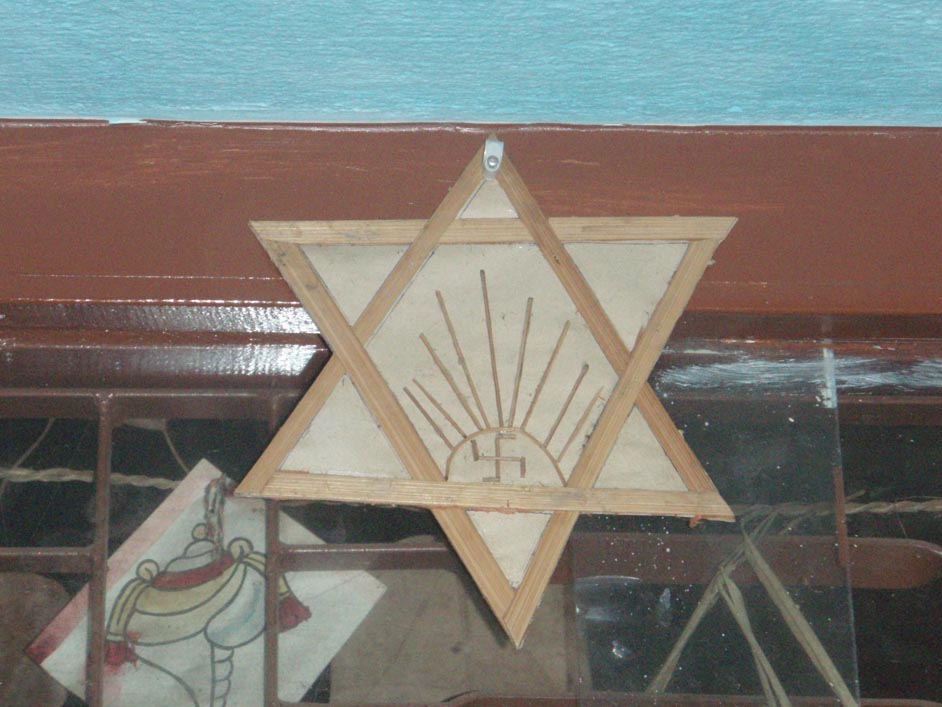 This six pointed star, which in our tradition is the sign of the cults that worship on Saturdays (cult of Saturn), in South Asia represents Saraswati, the goddess of learning and music. The Swastik sign represents continuity (among many other things), and is embedded within it. A rising sun of energetic rays emanate from the Swastik. CULTURAL RELATIVITY if I've ever seen a perfect example.
 A waterspout from a spring that is flowing pure, direct from the mouth of Shankar, an incarnation of the Lord of Yogis, Shiva.
 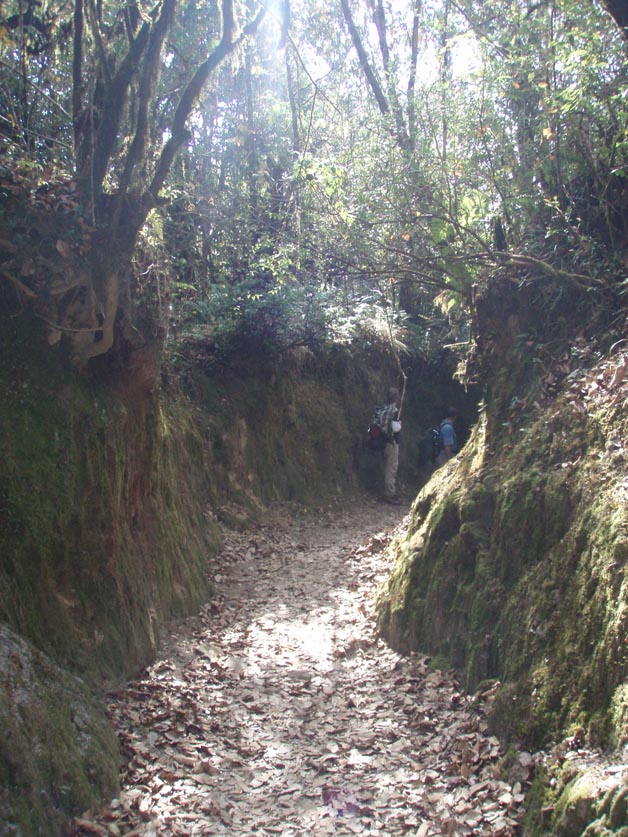 A trail in the Shivapuri National Park, where I went walking for a few days last week with the relations and my buddy Ian. The path snaked through an old wash, the sides of which hung onto tree roots, hanging above our heads at some points.
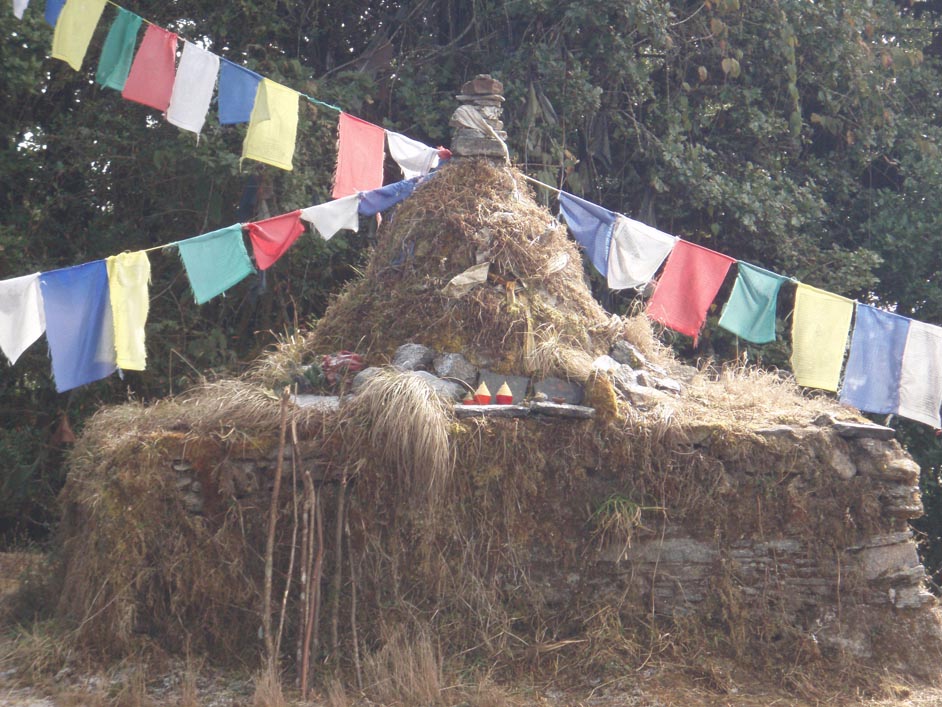 An old Buddhist stupa at the peak of Shivapuri hill (2,700 meters, about 8,000 feet), which marks the highest point of the northern rim of the Kathmandu Valley. While enjoying the sunshine, we met a young hindu yogi, in his early twenties, who had completed one month of meditation in the forest. He is scheduled to spend the next three years living in a cave near the peak, engaged in the pure life. He won't even touch anyone else for the duration.
 A Himalayan mountain view to the north from the northern rim of the Kathmandu Valley, where I went trekking with the relations last week.
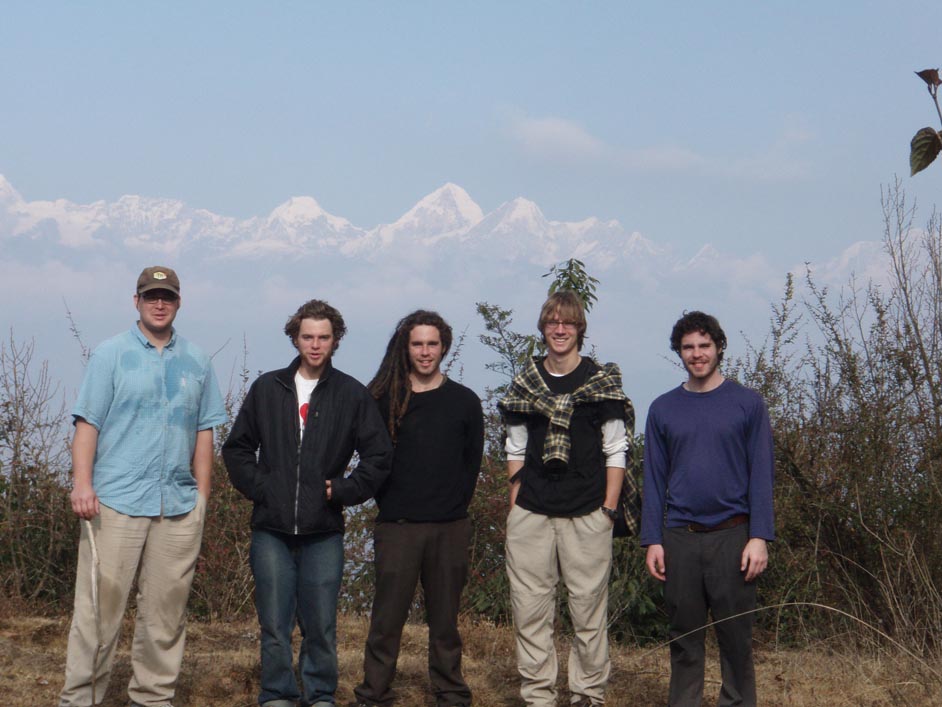 Our group, rambling through the mountains. Check www.khamabiding.blogspot.com for a brief description of our trip.
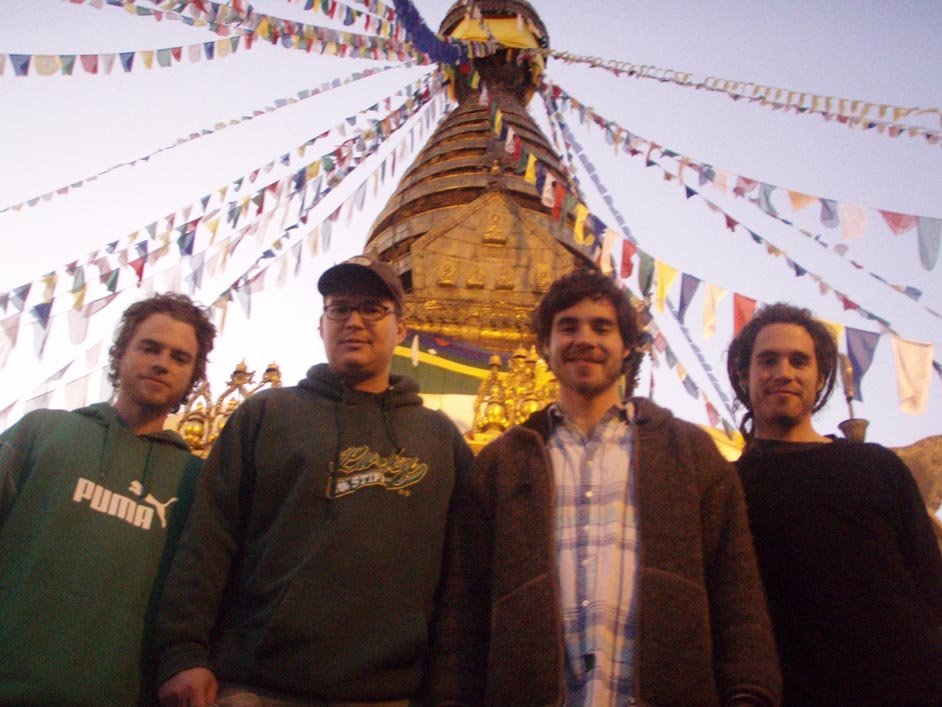 Older brother Chris, cousin Will, twin brother Daniel and I, standing in front of the impressive dome of the Swayambhunath stupa, perched on a hill in western Kathmandu.
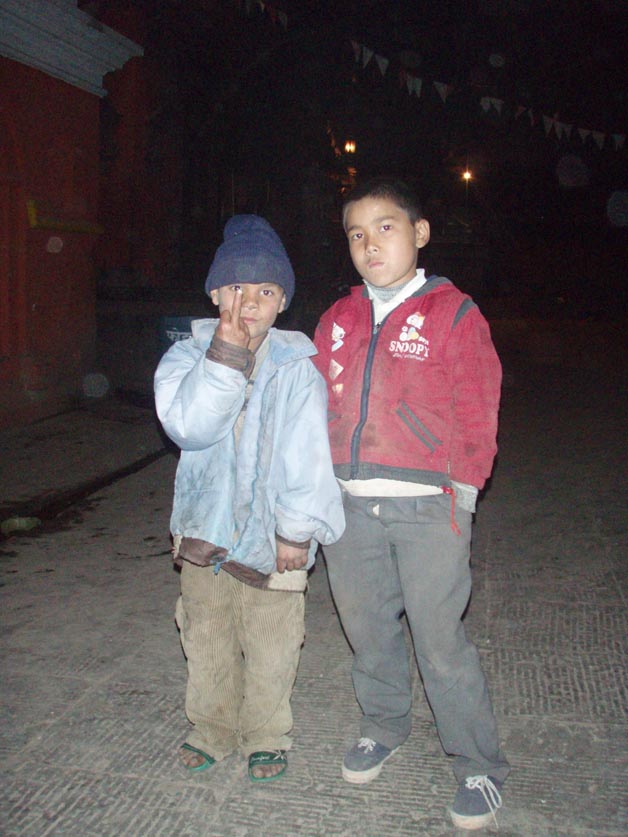 These two little kids asked me to take their photo as we were wandering around the historic part of Patan city last week. Right as I was snapping the photo, one of them quickly shot me the bird. I would have scolded him, but I was laughing way to hard.
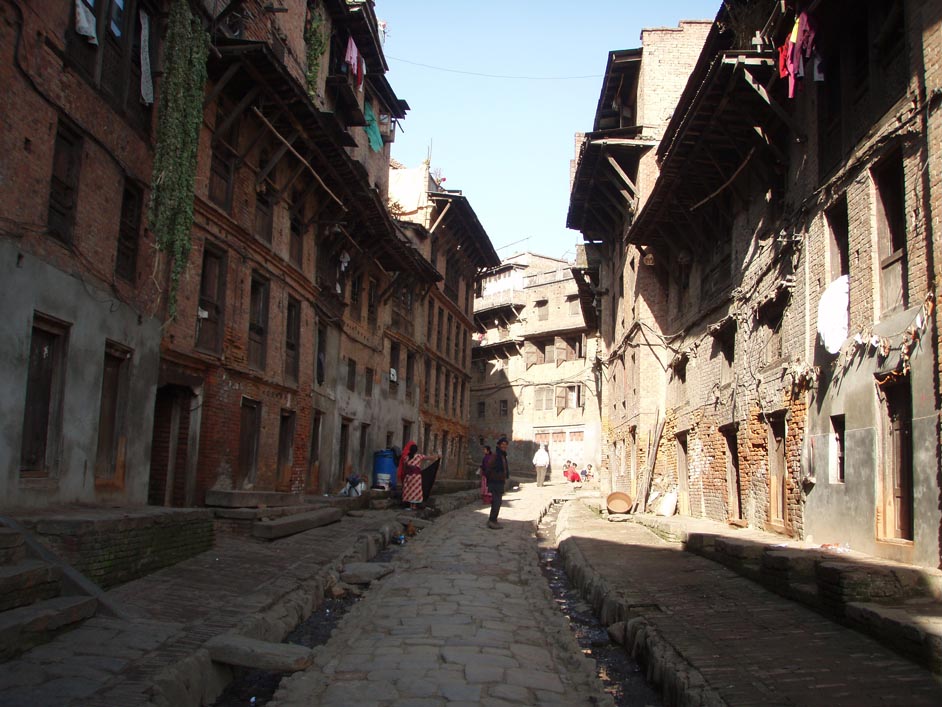 A street in Bhaktapur, the well preserved town in the eastern part of the Kathmandu Valley. The local government heavily subsidizes building the facades of buildings in the old Newari style of intricate brick and woodwork.
  Down by the river in Bhaktapur.
 The Shreegha stupa, in the middle of a very unique courtyard in Kathmandu, which has a Tibetan monastery, a Theravada (Burmese/Thai) monastery and nunnery, and a few traditional Newar Buddhist temples, and some Hindu temples, all together in the same place, sharing the old sacred space.
 A tree, draped heavily with prayer flags, on the hill at Swayambhu.
 A delicate local bushy reed made and sold all over Nepal as a hand held broom. The rusty roof of this village home is made of old vegetable oil tins, flattened out and nailed together.
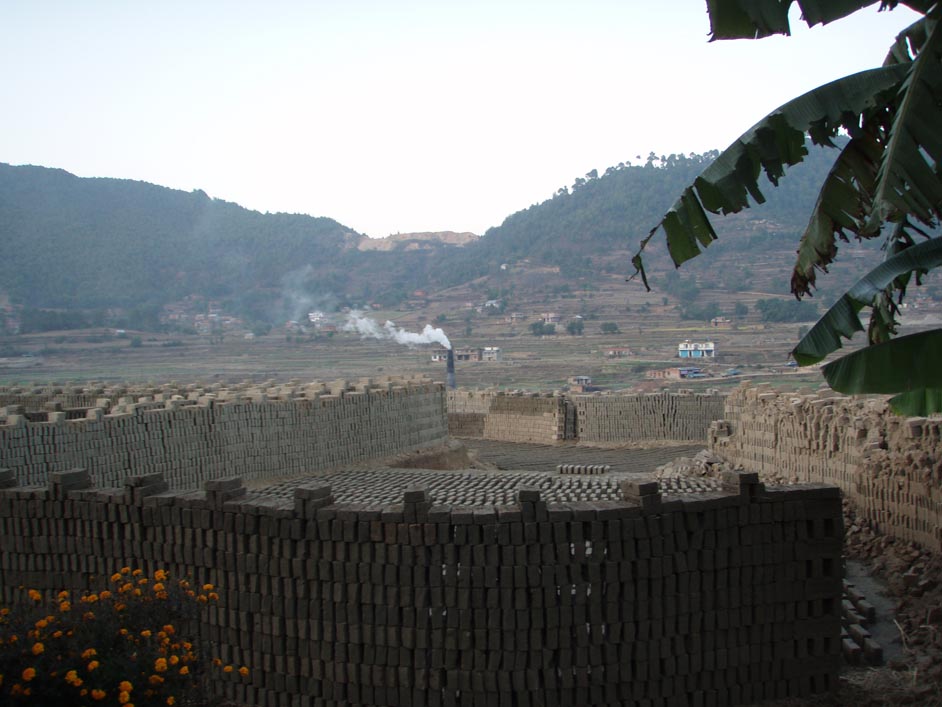 My friend sold the clay heavy dirt from her rice field in front of her house in Lelegoan to the local brick factory, in the distance. There was a failed campaign and protest programme to block the brick factory from being built. The air, once totally pristine, has slowly become more hazy due to the coal burning kilns. It has, however, brought some jobs and money into the rural economy.
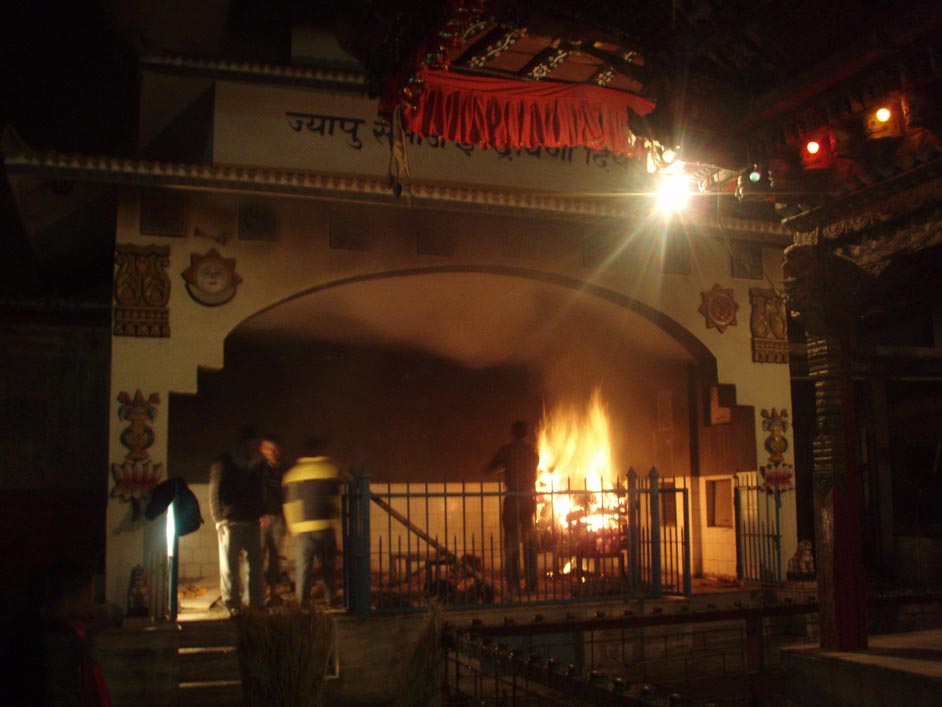 My cousin arrived in Kathmandu last week, and since he had slept a night in Delhi wasn't feeling very jetlagged. Therefore I took him for a walk around the western part of Kathmandu, and after crossing a bridge I realized I had never entered the little temple complex on the banks of that small river. We walked in and were suprised to see a large fire on a platform at the edge of the courtyard, dominated by a goddess temple. There were feet sticking out of the fire, it was a cremation of an old woman.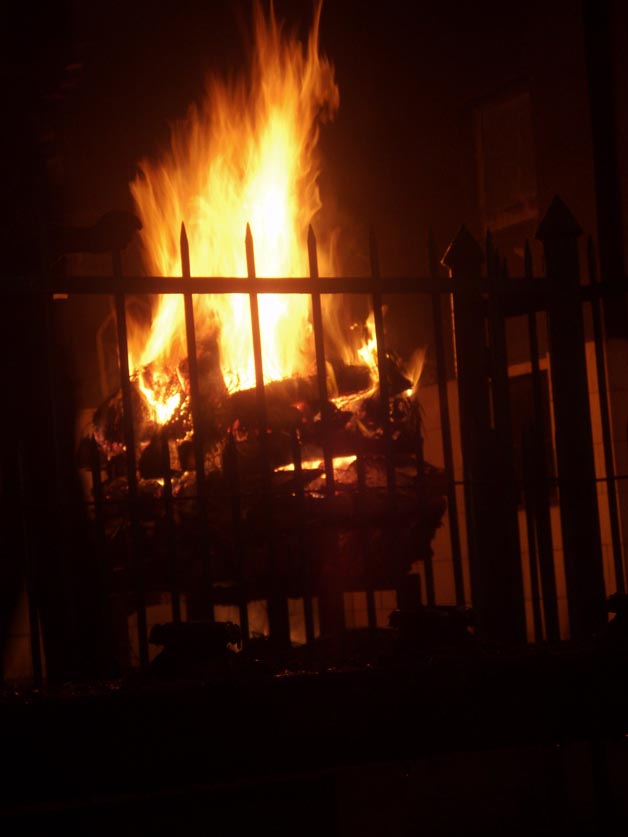
 Five young Nepali girls singing and dancing in Lelegaon village, perched on the southern edge of the Kathmandu Valley. The girls walk around to each house in the village belting local folk tunes in exchange for money and sweets.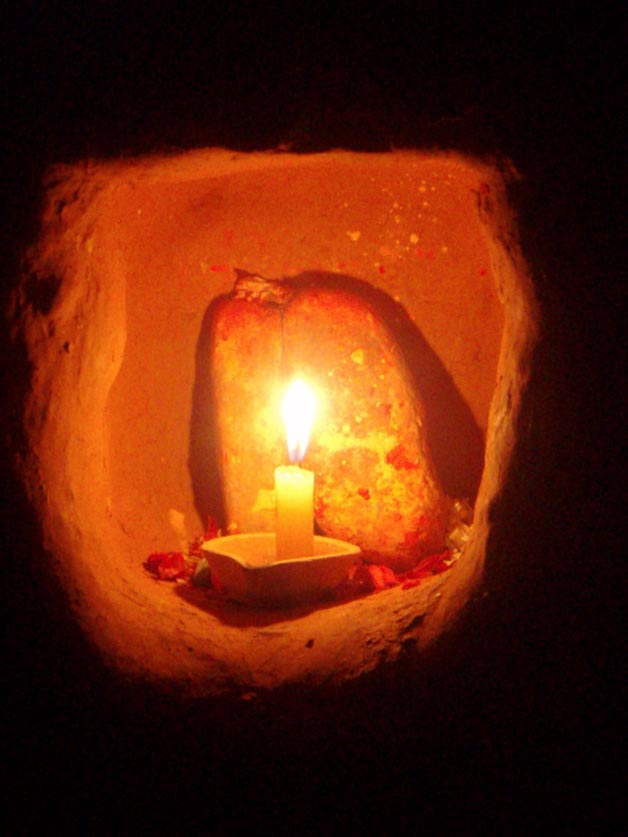

anger
sometimes a little thing makes us a bit annoyed, and we don't think to go splash our face with some water and take deep breaths, or apply any other antidote to anger that we may know. another small thing may happen, like we could drop a glass, leave our bag at the office, or someone we are with could be unhelpful, and suddenly these situations compound. typically they don't add, but multiply in a way that comes upon us unexpectedly. we have a certain bowl we like to use in the morning but our roommate didn't wash it since they made spaghetti the night before. we are walking down the road and someone looks at us in a way we don't like. someone won't stop honking their horn outside (a particular annoyance in Nepal). A friend needs a favor from us, it seems like we are always helping them without any reciprocity, and we wonder why we have become friends with this lost simpleton in the first place. We read the newspaper, and the politicians continue to ignore the facts about the world and more people are dying and there are new airstrikes and you wonder when it will be your turn to do some striking of your own to all the fuckers who are constantly trying to get your money or your time or at least make sure you have no peace of mind.
these are the times to look into our thoughts and try to find what it is that we are protecting.
these are the times to look into our thoughts and try to find what it is that we are protecting.
Tuesday, January 02, 2007
Some Perspectives on the Hanging of Saddam
Saddam's hanging has elicited a few interesting conversations with some Nepali and Tibetans in the last few days, and I would like to briefly share some of their feelings about it.
Dorje, the Tibetan man that I lived with for 3 months in 2003/2004, who has remained a close friend of mine, has often explained to me why he thinks that G.W. Bush and the Dalai Lama together are the great forces in the world making it a safer and better place. He listens to radio news and watches it on TV, both in Nepali and Tibetan, and loves to argue politics like most Asian men. We sometimes have lively discussions. Although I have often explained to him the many objections I have to Bush's foreign and domestic policy, until yesterday I have never really heard him raise doubt about Bush's actions. He said that although Saddam was really bad, he wasn't sure if killing him was the best option. He wondered if it would actually relieve Iraqis of the fear of one day coming again under Saddam's wrath or whether it would just result in more violence. He is generally pretty sensitive with me when talking about violence in Iraq, because he knows that I lost a childhood friend there this past year. He also expressed the sentiment that most everyone I've talked to about this with has raised: killing is wrong (sinful/creates negative karma/etc), and creates more suffering.
A Nepal taxi driver I was riding with, upon hearing that I was American, timidly asked if it was OK if he asked me a question. I replied "of course," and he asked me what I thought of Saddam's execution. I said it was a difficult question, because although he did a lot of terrible things, I am not sure that one can ever justify the death penalty. I believe that everyone is capable of rehabilitation, and agree with the maxim that if you want to judge a society, you should judge it by the way it treats its prisoners. The taxi driver agreed with me when I said that if you kill, it creates sin, regardless. He thought that it was a bad idea in the end to kill Saddam, but also didn't seem very sure of his opinion.
Today brothers Chris, Daniel and I visited a close Tibetan lama friend of mine, Phagchog Tulku Rinpoche. We joked a lot (he's quite young) and he gave Chris a beautiful Tibetan carpet wall hanging of the Kalacakra mantra as a gift. He has been my meditation teacher for 3 years and therefore I have a great amount of respect for him. He has also many times also argued with me about why Bush is such a great leader, and had a definate opinion about Saddam's hanging. He said that in Tibetan culture (and I imagine it is the same for many Asians), once you or your land has been captured by the enemy, you have already suffered the greatest defeat. Being imprisoned is the greatest shame for the warrior, not to mention the agony of having seen your two beloved sons, brought up by your own hand, brutally killed and displayed mangled all over international news. He said that it would have been a greater punishment for him to live out his days in jail, knowing that he had lost to the enemy, that he was defamed, forgotten and powerless. The final reason that he disagreed with the execution, of course very Buddhist, is that killing begets killing that begets more killing, etc.
Finally, I also should mention that there have been a number of street protests in Nepal by both some Muslim organizations and also so other activists denouncing the execution. The Dalai Lama made a request that his life be spared, and both the Prime Ministers of India and Nepal, where capital punishment has been eliminated, requested that the Iraqi government not execute Saddam in order to maintain stability in the region. The Prime Minister of Nepal, Koirala, gave a statement wishing that all the civilized nations of the world would abandon the use of capital punishment, and prayed the "message of Sai Baba" of peace and love to all people be spread throughout the world.
Dorje, the Tibetan man that I lived with for 3 months in 2003/2004, who has remained a close friend of mine, has often explained to me why he thinks that G.W. Bush and the Dalai Lama together are the great forces in the world making it a safer and better place. He listens to radio news and watches it on TV, both in Nepali and Tibetan, and loves to argue politics like most Asian men. We sometimes have lively discussions. Although I have often explained to him the many objections I have to Bush's foreign and domestic policy, until yesterday I have never really heard him raise doubt about Bush's actions. He said that although Saddam was really bad, he wasn't sure if killing him was the best option. He wondered if it would actually relieve Iraqis of the fear of one day coming again under Saddam's wrath or whether it would just result in more violence. He is generally pretty sensitive with me when talking about violence in Iraq, because he knows that I lost a childhood friend there this past year. He also expressed the sentiment that most everyone I've talked to about this with has raised: killing is wrong (sinful/creates negative karma/etc), and creates more suffering.
A Nepal taxi driver I was riding with, upon hearing that I was American, timidly asked if it was OK if he asked me a question. I replied "of course," and he asked me what I thought of Saddam's execution. I said it was a difficult question, because although he did a lot of terrible things, I am not sure that one can ever justify the death penalty. I believe that everyone is capable of rehabilitation, and agree with the maxim that if you want to judge a society, you should judge it by the way it treats its prisoners. The taxi driver agreed with me when I said that if you kill, it creates sin, regardless. He thought that it was a bad idea in the end to kill Saddam, but also didn't seem very sure of his opinion.
Today brothers Chris, Daniel and I visited a close Tibetan lama friend of mine, Phagchog Tulku Rinpoche. We joked a lot (he's quite young) and he gave Chris a beautiful Tibetan carpet wall hanging of the Kalacakra mantra as a gift. He has been my meditation teacher for 3 years and therefore I have a great amount of respect for him. He has also many times also argued with me about why Bush is such a great leader, and had a definate opinion about Saddam's hanging. He said that in Tibetan culture (and I imagine it is the same for many Asians), once you or your land has been captured by the enemy, you have already suffered the greatest defeat. Being imprisoned is the greatest shame for the warrior, not to mention the agony of having seen your two beloved sons, brought up by your own hand, brutally killed and displayed mangled all over international news. He said that it would have been a greater punishment for him to live out his days in jail, knowing that he had lost to the enemy, that he was defamed, forgotten and powerless. The final reason that he disagreed with the execution, of course very Buddhist, is that killing begets killing that begets more killing, etc.
Finally, I also should mention that there have been a number of street protests in Nepal by both some Muslim organizations and also so other activists denouncing the execution. The Dalai Lama made a request that his life be spared, and both the Prime Ministers of India and Nepal, where capital punishment has been eliminated, requested that the Iraqi government not execute Saddam in order to maintain stability in the region. The Prime Minister of Nepal, Koirala, gave a statement wishing that all the civilized nations of the world would abandon the use of capital punishment, and prayed the "message of Sai Baba" of peace and love to all people be spread throughout the world.
Friday, December 29, 2006
winding down
I escorted Uncle Bill and Aunt Merrilee back to the Kathmandu airport after a hasty sighteeing trip to the vast Pashupati Hindu Temple complex this morning. They will be happily back in Houston in a few days, and wondering if what they saw on the exact other side of the world actually was real, or they suffered from a collective dream orchestrated by one of their more essentric nephews, the one who seems to walk to a different beat regarding practically everything (commerce, education, religion, diet, hygiene) and has the gall to sometimes even act like everyone else is crazy.
Around three years ago, while living without friends or family or orientation in the orient, in kathmandu, I did feel like I was going crazy, and finally I think around the New Year 2004 came to terms with that insanity, and decided that it wasn't so bad after all. OM MANI PADME HUM HRI! Actually quite empowering, and fun...
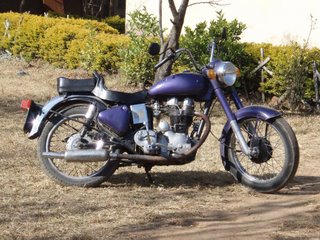
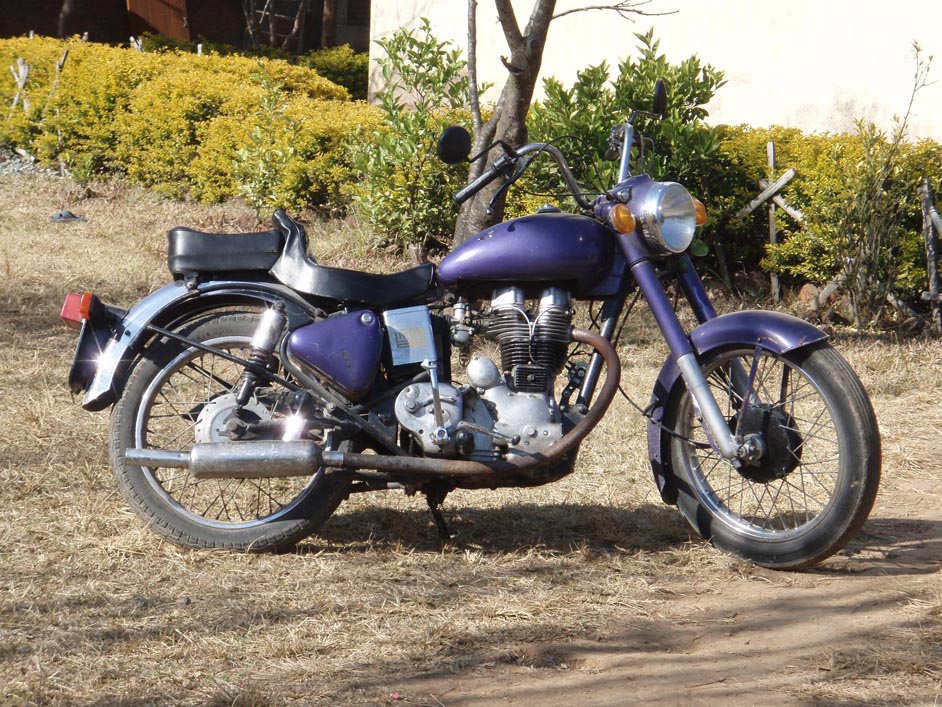
I will be back at the airport tomorrow morning to fetch the twin brother on this boss hog, my purple Royal Enfield Indian Bullet 350cc beater.
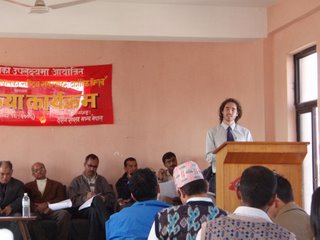
Last month I gave a speech on International Philosophy Day to the Nepal Philosophy Forum. I was asked to talk about the importance of spirituality, but I mainly discussed the necessity to act upon our words, rather than just talk about what would be nice. I also told a few humorous stories, and being the only westerner in the room, I think I was well recieved.
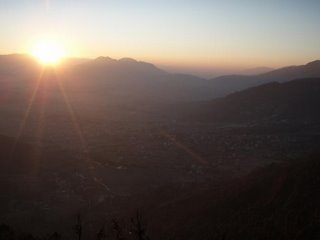
The sunset from the path north from Boudha to Nagi Hermitage, where I attended a short meditation seminar. The veiw is obviously to the west.
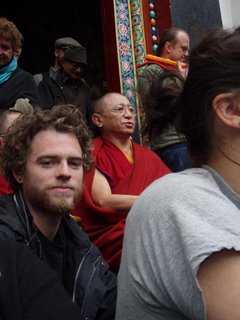 Chris with the venerable Chokyi Nyima Rinpoche, posing for a group photo after the 2006 Seminar on Vajrayana Buddhist Meditation at the White Monastery.
Around three years ago, while living without friends or family or orientation in the orient, in kathmandu, I did feel like I was going crazy, and finally I think around the New Year 2004 came to terms with that insanity, and decided that it wasn't so bad after all. OM MANI PADME HUM HRI! Actually quite empowering, and fun...
I will be back at the airport tomorrow morning to fetch the twin brother on this boss hog, my purple Royal Enfield Indian Bullet 350cc beater.

Last month I gave a speech on International Philosophy Day to the Nepal Philosophy Forum. I was asked to talk about the importance of spirituality, but I mainly discussed the necessity to act upon our words, rather than just talk about what would be nice. I also told a few humorous stories, and being the only westerner in the room, I think I was well recieved.
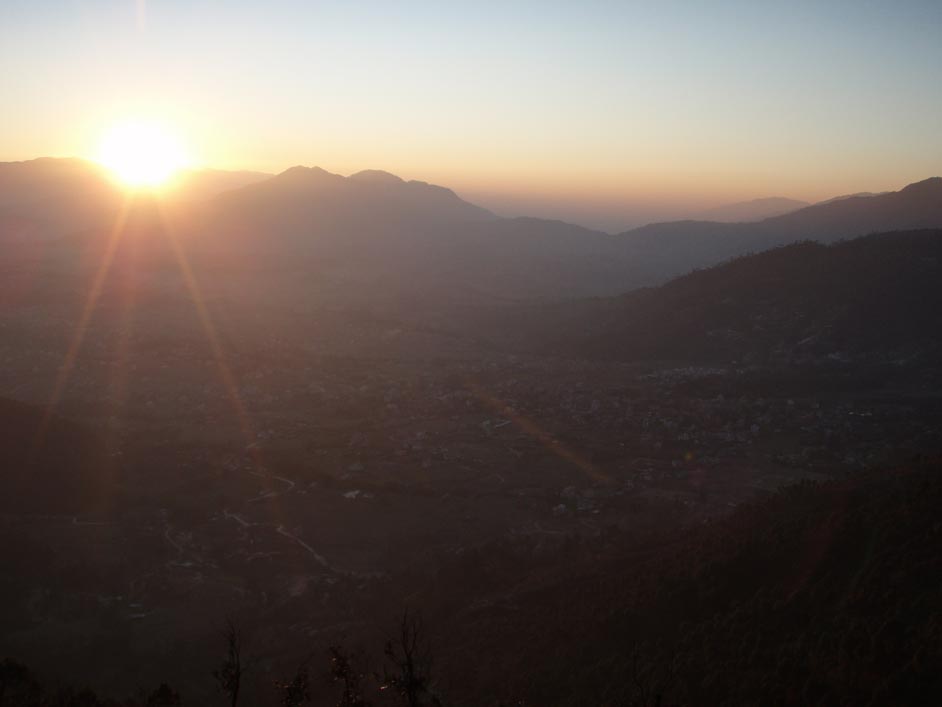
The sunset from the path north from Boudha to Nagi Hermitage, where I attended a short meditation seminar. The veiw is obviously to the west.
 Chris with the venerable Chokyi Nyima Rinpoche, posing for a group photo after the 2006 Seminar on Vajrayana Buddhist Meditation at the White Monastery.
Wednesday, December 27, 2006
about marijuana fields
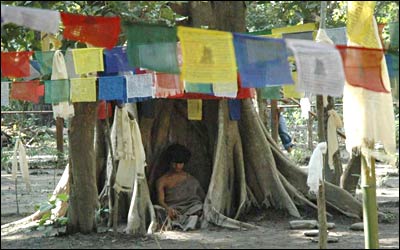
this photo was sent to me by my twin brother (khamabiding.blogspot.com), and the link below is an article about this meditating 17year old. he asked me to say a few words about him.
http://articles.news.aol.com/news/_a/nepals-mystery-buddha-boy-reappears/20061225202609990007?cid=2194
this is the famous "Buddha Boy" that has reemerged from hiding yesterday, this time with a sword. Apparently, he has been meditating constantly for many months without eating anything but wild herbs. Some say he is a reincarnation of the Buddha, which makes no sense, because according to Buddhist cosmology BUDDHAS DO NOT REINCARNATE as the media and also the Chinese government likes to think. Buddhas are no longer ruled by the law of the cause and effect of actions (karma), and therefore are out of cyclic existence and do not take rebirth in one of the six realms of existence. Although all beings take rebirth, only very highly advanced meditation practitioners can purposely direct their consciousness to its next birth, like the Dalai Lama. Maybe this kid is a reincarnation of a great spiritual master, but not the Buddha. This is basic stuff.
As I'm living in Kathmandu I haven't gotten out to the remote location he has been meditating, nor do I feel compelled at all to, because as a meditation practitioner I realize that he probably wants nothing more than just to be left alone until he is finished doing what he has set out to do, which seems to be silent quiet solitary retreat for many years. My advice to people who are interested or want to meet him is not to, rather they should go learn some meditation practice themselves from a teacher who is willing to actually talk right now to students, and leave the poor kid alone. That is the reason he disappeared in the first place, and also may be the reason he's carrying a sword now.
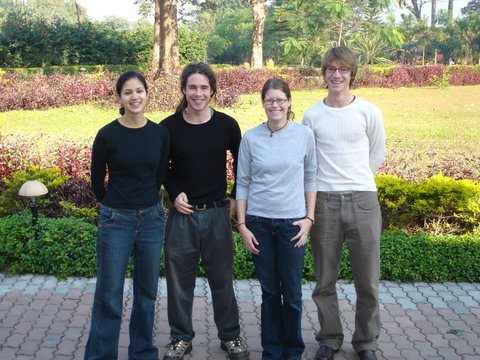 a photo of three of the other fulbright scholars with me at the Fulbright South Asia Conference on study abroad last week, held in the Indian state of West Bengal.
 Uncle Bill and Aunt Merrilee are in Nepal for 4 days visiting over the holidays, a hop skip and a jump away from Kuala Lampur in Malaysia where my Uncle has been teaching piping design for 6 weeks. Its been fun, and it looks like they are getting a lot out of the new experience and perspective of one of the least developed nations in asia. We've gone for a day trip to the town Bhaktapur in the eastern part of the Kathmandu Valley and today visited Chapagaon, the town where I have been staying in a monastery and also went to Lelegaon, a village at the southern edge of the Kathmandu Valley, because they wanted to see how average Nepalis really lived, and that requires going to the farming villages.
Uncle Bill informed me that there had been some whispers around the family about a picture I have posted of myself standing in front of some very large marijuana plants (gasp!). It is a real photo of me with the real devil weed, clutching the branches of the menace of society in my arms with a great big grin. I have a few things to say about this.
a)marijuana and hemp grow wild all over south asia and other parts of the world, and used to grow wild all over north america as well. for this reason one often encounters it while walking around the hills of Nepal, where the particular photo in question was taken.
b)the marijuana plants in the photo were definately cultivated intentionally, because the buds of the marijuana plant are mixed with grain and other herbs as a particularly affective medicine for goats and cows with stomach illness and indigestion. it is quite common to find some growing or drying around the villages of Nepal.
c)posing in front of large patches of marijuana is funny.
d)even if it were a forest of pot that was being grown to smoke, why is that a big deal? although it is illegal in most countries due to the misinformation of mr. anslinger, medical science has taught us that marijuana when smoked is usually nothing more than a mild high that is nontoxic and has never been fatal, and is much less destructive than alcohol and much less lethal than cigarettes, both of which are abused by millions and kill thousands daily. i personally consider cigarettes to be the most dangerous and personally destructive of all substances that can be consumed, next to poisons.
e)regardless of people's opinions, i have been completely clean of any drugs, or marijuana, or any other smoke, or even a drop of alcohol for the past 5 months, and will continue in this lifestyle for the next 5 months, as i have taken a strict vow for the said period.
lets move beyond the stigma and demonization of marijuana, there are much more important things to think about and waste our breath on.
Saturday, December 23, 2006
a question from a friend
recently a good friend asked me in email whether or not altruism is an appropriate desire.
i think this represents a misunderstanding of Buddhism, coming out of the simplistic way the Dharma is often presented. This is not confined to westerners, but i do think that an emphasis on a very old Pali textual tradition of Buddhism that likes to present itself as the original teachings of the Buddha, without historical change or "corruption," that has been overemphasized by those that write on "pure Buddhist philosophy" without the degradation of guru worship/Buddha image worship/belief in spirits/etc.
Therefore, we often hear the classical maxim, a restatement of the 4 Noble Truths uttered by the Buddha in Sarnath that "since suffering comes from desire, by eliminating desire we eliminate suffering, which leads to nirvana." this summer a Chicago man I met in Dharamsala at my hotel replied that he wasn't going to attend the teachings by His Holiness the Dalai Lama that were going on a short walk away because he found that if you had heard one teaching on Buddhism you had heard them all, since Buddhism is really just telling us to give up all pleasures.
What, really?
No.
"the roads of excess lead to the palaces of wisdom" -william blake
from an orthodox vajrayana buddhist point of view (a historical and philosophical development, emphasizing the effectiveness of ritual, that is most commonly represented by Tibetan Buddhism), it is absolutely
essential to have many different kinds of desire to quickly reach
enlightenment. these include the desire [the tibetan word 'dod pa
means wish/want/desire, the word for the negative kind of desire is
'dod chags, which connotates a clinging or attachment to that which is
desired] that all beings may have happiness and its causes, the desire
that all beings may be divorced from suffering and its causes, the
desire for enlightenment, the desire to make your own mind like that
of the enlightened guru's, etc.
"How can we repay the kindness of the sentient beings? Through showing them immaculate love and compassion. Immaculate love is the thought, 'May they have happiness and its causes.' Compassion is the wish, 'May they be free of suffering and its causes.' Because to obtain happiness and to avoid suffering are the two most primordial, inborn instincts of all that live, to give love and compassion is the supreme gift." - His Holiness the Dalai Lama, from "The Path to Enlightenment."
in this way, desire is part of the raft that carries us over to the
other shore beyond the oceanlike suffering of our neurotic mind, and
that raft should be abandoned once we land the raft.
however, we're still on the raft.
there is a misperception that all desire is bad. some desire can be a
shortcut to understanding. especially if you can look into your mind
on the occasions when you are really attached to something or having
lots of desirous feelings. examine where they come from and where
they go, whether they remain and what they are based on. you may see
that they are really just a composition of thoughts and feelings, many
of which are irrational or baseless and that there is nothing substantial to really
point at.
Calm Abiding meditation helps with this. I am saddened to see people that engage in meditation beating themselves up over their negative emotions, lack of clarity, and inability to concentrate, all of which become more apparent when sitting back and examining the mind. These things naturally come up, over and over again. However, they will gradually subside, and we may not even notice that we are less attached to getting our own preferences, and less inclined to react angrily. We may even have the occasional genuine thought like "Well, he's a nice guy, and although I like this girl that we've both been dancing with, if she decides to go out with him, that's alright," or something similar.
it is said that wisdom and the altruistic desire for all beings
to be enlightened (bodhicitta) are like the opposite sides of the same
coin, or two wings of a bird. wisdom, being the realization that
there is no intrinsically real self, is expressed spontaneously through altruistic
activity. although suffering may ultimately be an illusion, since we
interact with it as if it were real, it is real to our minds, and
therefore important to adress. and those who act with a great amount
of altruism will naturally begin to understand what selflessness is
all about. in our culture, we call this "wise."
in a nutshell, some desires are good, and all desires can be skillfully used with the correct training to understand the wisdom of selflessness. so don't feel bad if you find yourself desiring in a destructive way, you are a person afterall, and you aren't a monk, so relax and take some breaths, and see what happens.
i think this represents a misunderstanding of Buddhism, coming out of the simplistic way the Dharma is often presented. This is not confined to westerners, but i do think that an emphasis on a very old Pali textual tradition of Buddhism that likes to present itself as the original teachings of the Buddha, without historical change or "corruption," that has been overemphasized by those that write on "pure Buddhist philosophy" without the degradation of guru worship/Buddha image worship/belief in spirits/etc.
Therefore, we often hear the classical maxim, a restatement of the 4 Noble Truths uttered by the Buddha in Sarnath that "since suffering comes from desire, by eliminating desire we eliminate suffering, which leads to nirvana." this summer a Chicago man I met in Dharamsala at my hotel replied that he wasn't going to attend the teachings by His Holiness the Dalai Lama that were going on a short walk away because he found that if you had heard one teaching on Buddhism you had heard them all, since Buddhism is really just telling us to give up all pleasures.
What, really?
No.
"the roads of excess lead to the palaces of wisdom" -william blake
from an orthodox vajrayana buddhist point of view (a historical and philosophical development, emphasizing the effectiveness of ritual, that is most commonly represented by Tibetan Buddhism), it is absolutely
essential to have many different kinds of desire to quickly reach
enlightenment. these include the desire [the tibetan word 'dod pa
means wish/want/desire, the word for the negative kind of desire is
'dod chags, which connotates a clinging or attachment to that which is
desired] that all beings may have happiness and its causes, the desire
that all beings may be divorced from suffering and its causes, the
desire for enlightenment, the desire to make your own mind like that
of the enlightened guru's, etc.
"How can we repay the kindness of the sentient beings? Through showing them immaculate love and compassion. Immaculate love is the thought, 'May they have happiness and its causes.' Compassion is the wish, 'May they be free of suffering and its causes.' Because to obtain happiness and to avoid suffering are the two most primordial, inborn instincts of all that live, to give love and compassion is the supreme gift." - His Holiness the Dalai Lama, from "The Path to Enlightenment."
in this way, desire is part of the raft that carries us over to the
other shore beyond the oceanlike suffering of our neurotic mind, and
that raft should be abandoned once we land the raft.
however, we're still on the raft.
there is a misperception that all desire is bad. some desire can be a
shortcut to understanding. especially if you can look into your mind
on the occasions when you are really attached to something or having
lots of desirous feelings. examine where they come from and where
they go, whether they remain and what they are based on. you may see
that they are really just a composition of thoughts and feelings, many
of which are irrational or baseless and that there is nothing substantial to really
point at.
Calm Abiding meditation helps with this. I am saddened to see people that engage in meditation beating themselves up over their negative emotions, lack of clarity, and inability to concentrate, all of which become more apparent when sitting back and examining the mind. These things naturally come up, over and over again. However, they will gradually subside, and we may not even notice that we are less attached to getting our own preferences, and less inclined to react angrily. We may even have the occasional genuine thought like "Well, he's a nice guy, and although I like this girl that we've both been dancing with, if she decides to go out with him, that's alright," or something similar.
it is said that wisdom and the altruistic desire for all beings
to be enlightened (bodhicitta) are like the opposite sides of the same
coin, or two wings of a bird. wisdom, being the realization that
there is no intrinsically real self, is expressed spontaneously through altruistic
activity. although suffering may ultimately be an illusion, since we
interact with it as if it were real, it is real to our minds, and
therefore important to adress. and those who act with a great amount
of altruism will naturally begin to understand what selflessness is
all about. in our culture, we call this "wise."
in a nutshell, some desires are good, and all desires can be skillfully used with the correct training to understand the wisdom of selflessness. so don't feel bad if you find yourself desiring in a destructive way, you are a person afterall, and you aren't a monk, so relax and take some breaths, and see what happens.
Friday, December 08, 2006
mail?
so i don't know if i ever update this, but if anyone is feeling like sending a letter or package (christmas is on the way, my birthday is in february, i am a pisces, by the way, ladies):
Michael Smith
Fulbright Commission
P.O. Box 380
Gyaneshwar, Kathmandu, Nepal, Asia
if anyone wants anything cool sent them from asia, i have a good shipping connection, so email me kilgoresmith@gmail.com for tibetan/indian/nepali goods.
Michael Smith
Fulbright Commission
P.O. Box 380
Gyaneshwar, Kathmandu, Nepal, Asia
if anyone wants anything cool sent them from asia, i have a good shipping connection, so email me kilgoresmith@gmail.com for tibetan/indian/nepali goods.
monk photos
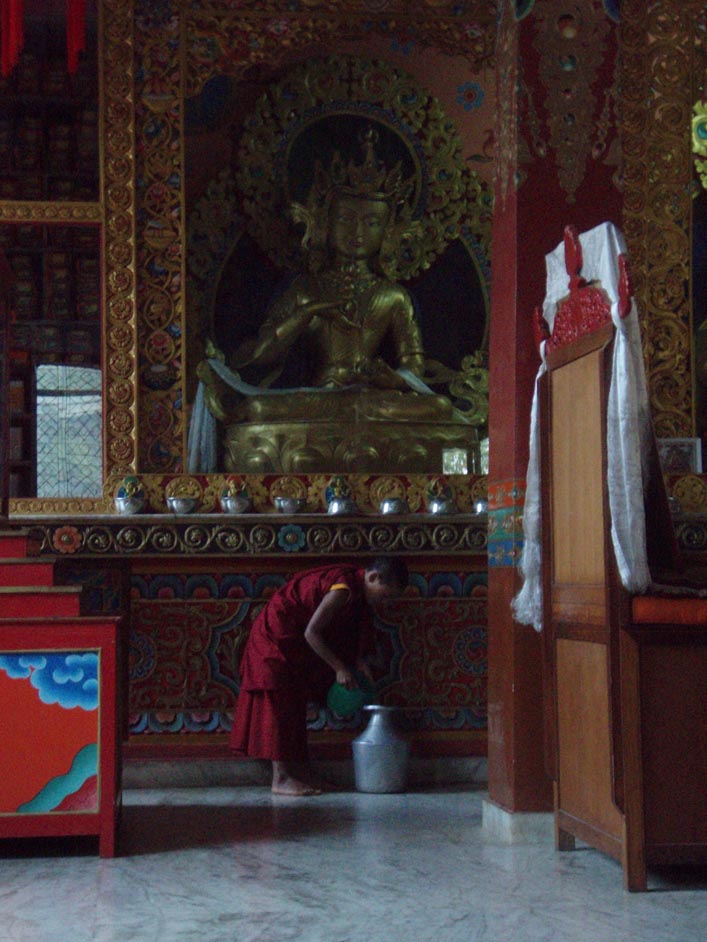 A younger monk at the Chapagaon monastery named Sangye (Buddha), emptying water offering bowls during the evening protector diety offering ceremony. He is in front of a statue of Vajrasatva, the Bodhisattva of purification. His practice also heals illness and amends negative deeds.
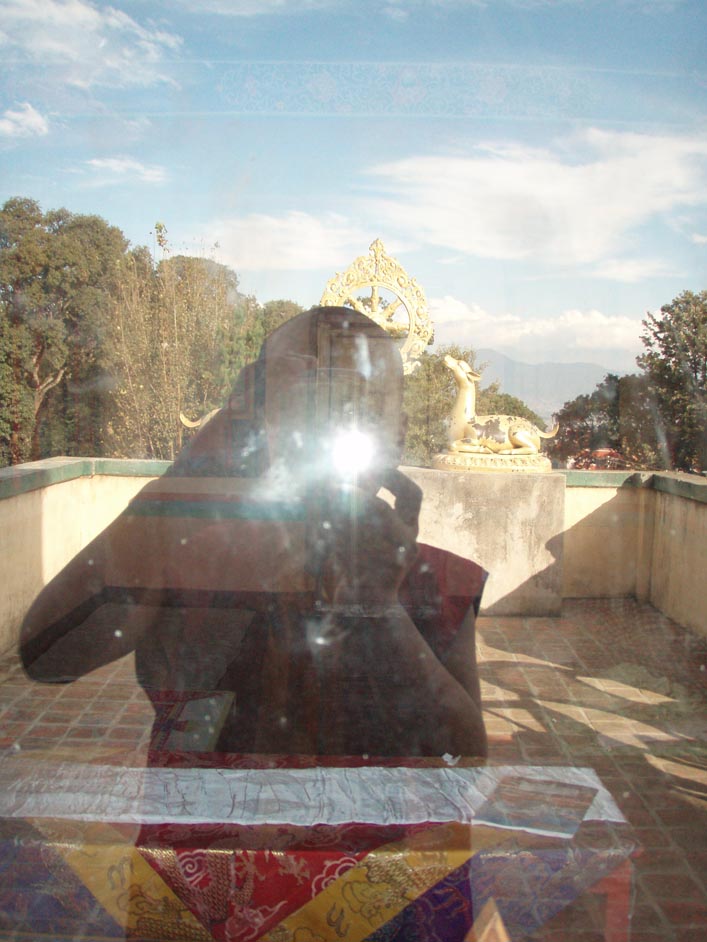 I let some of the younger monks play with my digital camera (i have a shock resistant olympus) and a few pictures turned out quite amazing, like this one, taken looking into one of the upstairs prayer rooms.
 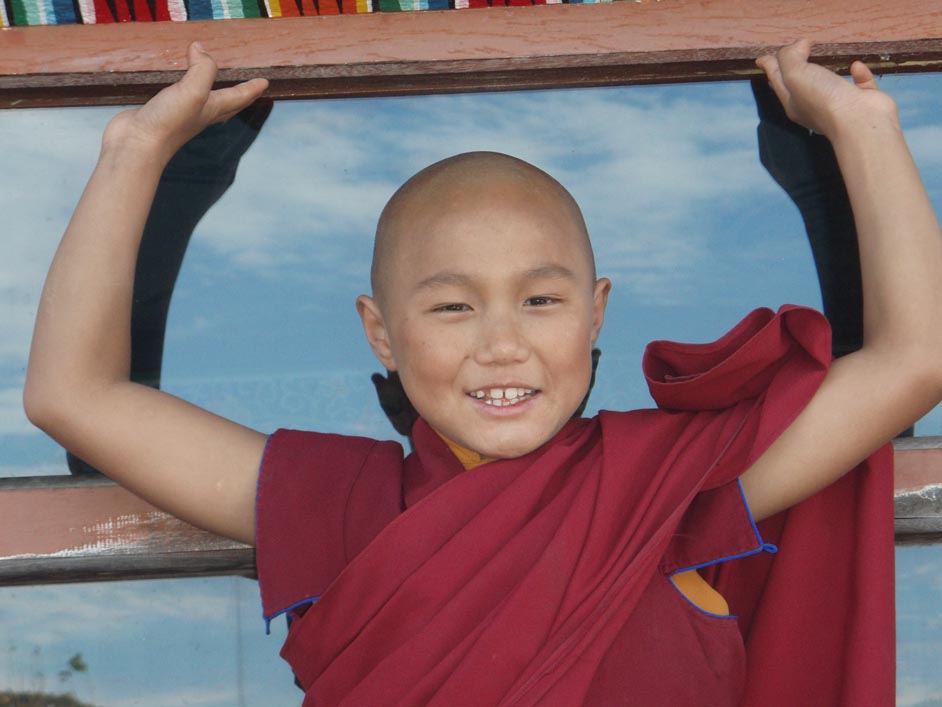 also taken by one of the younger monks at the monastery, this picture is very charming. i think they had a lot of fun with the camera. i am inspired by the New Orleans Kids Camera Project.
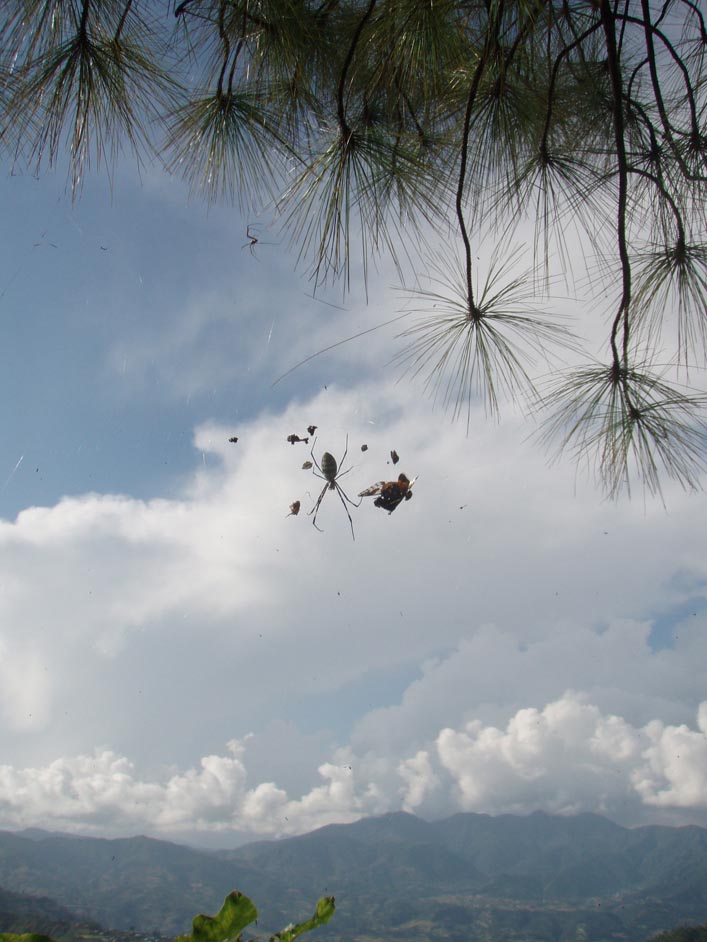 A spider in her web next to her dinner, taken on the hike south over the Kathmandu Valley rim from Lelegaon. The view looks north towards Kathmandu.
some more pictures, finally. since i've been in boudha, even though there are many options for internet, unfortunately i've found myself too busy to get online for very long in the afternoons (the mornings are reserved for mental cultivation, unless something very important is up).
tonight ram and santoshi are making a feast for a friend's birthday, and it looks like we'll go out to the tourist area of kathmandu for some reggae music and juice (other people will be enjoying beer, etc., i am still in the midsts of a one year detox...), and tomorrow night chris and i have been told to go to a punk/reggae show in town which should be pretty cool. the music scene is slightly looking up these days in kdu.
today i began meeting with my old tibetan language professor, Thinlay Dhondrup, for a daily class. we are reading the text i have been translating together, from the beginning, in order for me to put together a mistake free translation. i have translated the first 45 pages of the 60 pages with many mistakes and questions, we can go fast, though, because i've already put a lot of work into it. our class is held in tibetan, no english if possible. the text is a commentary by Chokyi Dragpa of the Preliminary Practices for Jigme Lingpa's treasure, the Heart Essence of the Vast Expanse.
Thursday, November 30, 2006
on the way up the hill
this afternoon i will walk north from our east kathmandu neighborhood into the hills. it won't take but about twenty minutes to be outside of the madness of town, into a village along the road that winds north east up the valley sides. gentle hills give way to mountainside, and after a few hours i will be happily sitting at the Nagi Gompa, a Tibetan Buddhist nunnery for a three day meditation retreat with some of the practitioners from the seminar chris and i attended over the last two weeks, led by the presiding lama, Chokyi Nyima Rinpoche.
i'll be crashing in a tent on the lawn of the monastery, and should have a great view of kathmandu in the valley below. carrying my little tripod so maybe i can get a decent sunset shot of the city, or nighttime lights.
chris is staying in town to continue his tibetan drawing and painting classes, which seem to be giogn well, although i think it is difficult for him to sit cross legged all day the way asians do.
yesterday as i was walking to a shiatsu massage appointment, i met Lama Tsering Wangdu on the circumambulation path around the Boudhanath stupa (by met I mean saw him and stalked him down), said hello, and he replied that I should go to his monastery. After the massage, I walked across the neighborhood down the Boudha road to Tusal, and upon arrival at the gompa (monastery) discovered that he was about to commence a long life empowerment, requested and sponsored by a group of twenty or so Newari women, mostly middle aged and elderly. They have a close connection to Lama Wangdu because he used to live in Jawalakhel at a Tibetan refugee camp near Patan, where many Newar Buddhists live.
The long life empowerment is technically a ritual empowerment or permission to practice the mantra and visualization meditation of Amitayus (Tsepagme), the Buddha of Infinite Life. Once done with the ceremony, the thirty or so local students of Lama Wangdu finished their chod feast offering, and after two plates of delicious rice and lentils with curry vegetables, i walked home to meet chris and watched a cheesy Korean sword action movie.
Off to the hills!
i'll be crashing in a tent on the lawn of the monastery, and should have a great view of kathmandu in the valley below. carrying my little tripod so maybe i can get a decent sunset shot of the city, or nighttime lights.
chris is staying in town to continue his tibetan drawing and painting classes, which seem to be giogn well, although i think it is difficult for him to sit cross legged all day the way asians do.
yesterday as i was walking to a shiatsu massage appointment, i met Lama Tsering Wangdu on the circumambulation path around the Boudhanath stupa (by met I mean saw him and stalked him down), said hello, and he replied that I should go to his monastery. After the massage, I walked across the neighborhood down the Boudha road to Tusal, and upon arrival at the gompa (monastery) discovered that he was about to commence a long life empowerment, requested and sponsored by a group of twenty or so Newari women, mostly middle aged and elderly. They have a close connection to Lama Wangdu because he used to live in Jawalakhel at a Tibetan refugee camp near Patan, where many Newar Buddhists live.
The long life empowerment is technically a ritual empowerment or permission to practice the mantra and visualization meditation of Amitayus (Tsepagme), the Buddha of Infinite Life. Once done with the ceremony, the thirty or so local students of Lama Wangdu finished their chod feast offering, and after two plates of delicious rice and lentils with curry vegetables, i walked home to meet chris and watched a cheesy Korean sword action movie.
Off to the hills!
Wednesday, November 29, 2006
lingering in boudha
Big bro Chris has been well occupied taking some drawing classes in the afternoons with a Tibetan painter friend of mine that also lives in our neighborhood, Boudha. Tomorrow or the next day he will begin as a full time student at the Tsering Art school at the Shechen Monastery here, which has a pretty vigorous traditional routine: 30 minutes of prayer followed by 3 hours of drawing class in the morning, 2 hour lunch nap break, some prayer at 2pm, and 3 hours of painting class in the afternoon. He'll continue this through Jan 10 or so when he leaves Nepal for the Big Easy.
We attended the annual seminar on Buddhist philosophy and practice at the White Monastery in Boudha, I had been looking forward to it greatly and am sad it is over. However, there is a follow up retreat this weekend up in a small hermitage on the rim of the Kathmandu Valley this weekend, I'm going to walk up from our apartment building in Boudha to the hermitage with a sleeping bag and tent (3 hours or so) and walk back, so it'll be kind of like camping. Mostly meditation up there, I went three years ago and it was splendid.
I caught Chris meditating this morning in his room, I'm feeling a bit proud of that, rejoicing in an attempt at recognizing the natural state, or at least calming down a bit.
things are well these days, i've been able to redirect a lot of my fulbright money towards monasteries and nunneries, trying to purify a little of the collective negative karma of the american government and being an american. we have all been complicit in many terrible deeds. (as well as good ones like sending a hopeless spacecadet like myself to hang out with buddhists and try to let something rub off if possible).
"the mind is like a crystal, which takes the color of the fabric that you set it upon. therefore to practice virtue it is necessary to keep virtuous friends dear and distance yourself from those that engage in non-virtue." - Dilgo Khyentse Rinpoche.
We attended the annual seminar on Buddhist philosophy and practice at the White Monastery in Boudha, I had been looking forward to it greatly and am sad it is over. However, there is a follow up retreat this weekend up in a small hermitage on the rim of the Kathmandu Valley this weekend, I'm going to walk up from our apartment building in Boudha to the hermitage with a sleeping bag and tent (3 hours or so) and walk back, so it'll be kind of like camping. Mostly meditation up there, I went three years ago and it was splendid.
I caught Chris meditating this morning in his room, I'm feeling a bit proud of that, rejoicing in an attempt at recognizing the natural state, or at least calming down a bit.
things are well these days, i've been able to redirect a lot of my fulbright money towards monasteries and nunneries, trying to purify a little of the collective negative karma of the american government and being an american. we have all been complicit in many terrible deeds. (as well as good ones like sending a hopeless spacecadet like myself to hang out with buddhists and try to let something rub off if possible).
"the mind is like a crystal, which takes the color of the fabric that you set it upon. therefore to practice virtue it is necessary to keep virtuous friends dear and distance yourself from those that engage in non-virtue." - Dilgo Khyentse Rinpoche.
Wednesday, November 15, 2006

working on the computer with little monks everywhere getting into my stuff and having a blast. they love to sit with me and watch me type or upload photos or translate, which is how i spend a lot of my afternoon unless i'm bouncing around kathmandu or the countryside on my motorcylce to meet someone or entertain or be entertained.

the spiritual epicenter of the neighborhood where big brother chris will be spending the next two months, the bodhanath stupa, the largest buddhist monument in nepal and one of the largest (and oldest of its type) in asia. VIBIN'.

i let some of the little ones take my digital camera (i got this model because of its durability and shockproofness) and run around taking photos of each other. this is one of the particularly cute ones (that was actually in focus) that came out.
back in the shitty
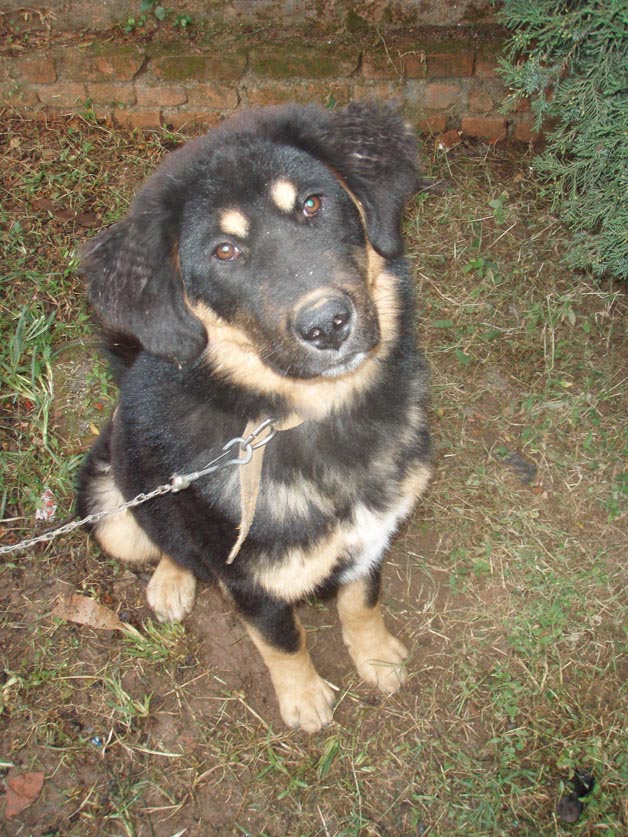
one of our ferocious guarddogs at the monastery in Chapagaon, Gonpo [protector] is the absolute friendliest cutest Tibetan mastiff I've ever met, he loves scratches on the tummy, like all puppies.
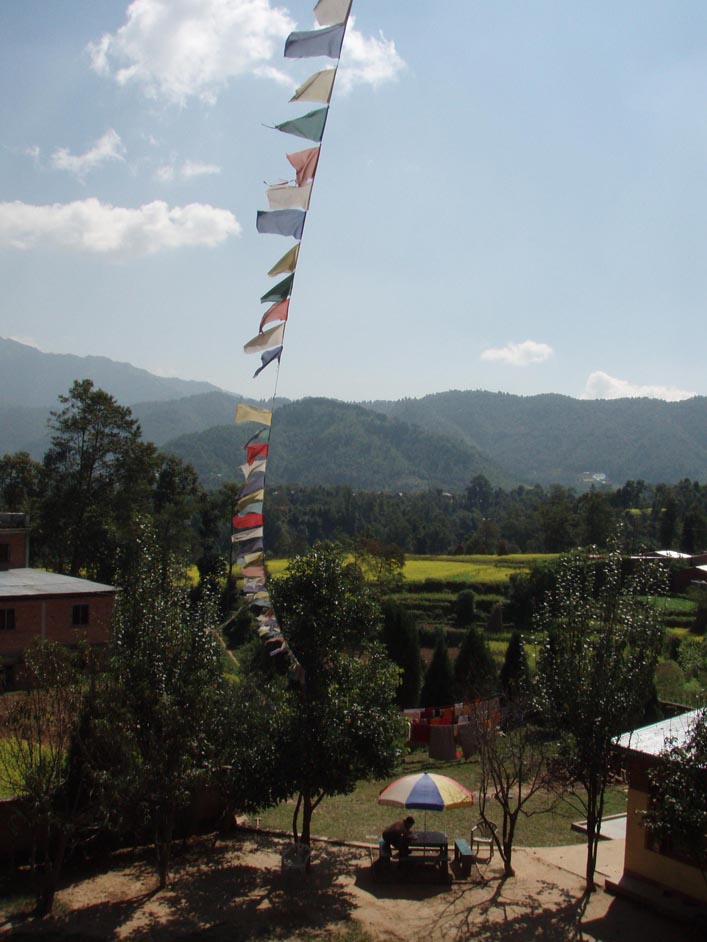
a veiw to the southeast from the window of the monastery in chapagaon.
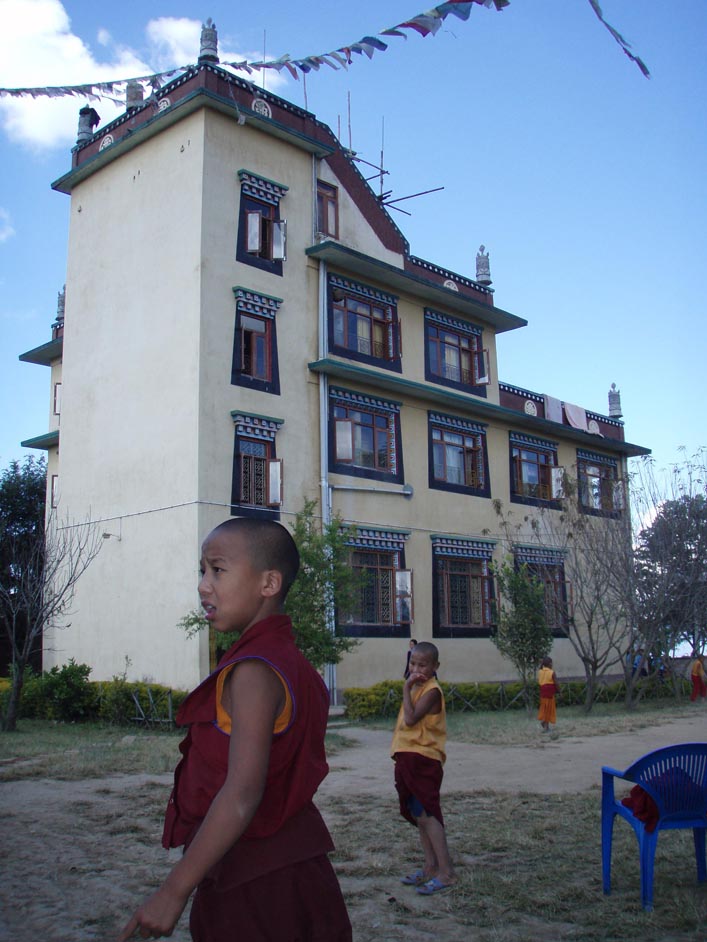
some of the young monks hanging out in the sun outside the monastery on Sunday, which is a day of play for them. after all, most of the monks that i live with are about 12 years old.
older brother chris arrived in kathmandu a few days ago, although his bags remained in thailand enjoying the beaches and fruit cocktails for a few extra days without him. Despite the hassle, we managed to get the luggage and spent his first three days in chapagaon at the monastery where i have been studying, and then for a day in the even smaller village of lelegaon hiking around in the beautiful hills outside of kathmandu.
Subscribe to:
Posts (Atom)